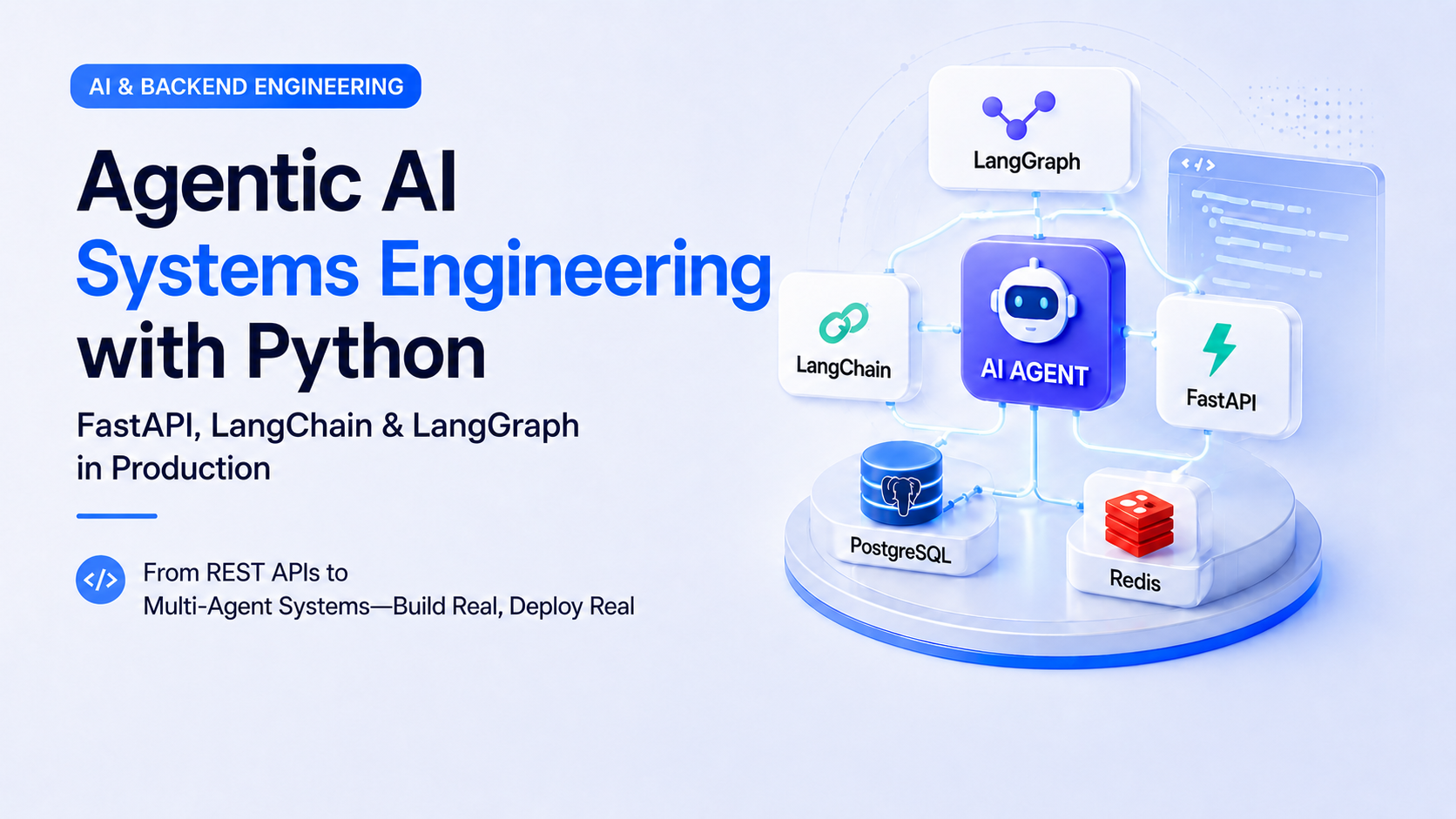
Agentic AI Systems Engineering with Python
Level: intermediateLanguage: English / বাংলা
Agentic AI Systems Engineering with Python
Agentic AI is not just about calling an LLM API. Learn how to engineer real AI systems that reason, use tools, manage state, retrieve knowledge, and run safely in production.
Build production-style agentic AI backends with Python, FastAPI, PostgreSQL, Redis, LangChain, LangGraph, RAG, structured outputs, tool calling, multi-agent orchestration, Docker and observability.
Most AI courses teach prompts. This course teaches you how to engineer production-style agentic AI backends. In 10 weeks, you will build systems using Python, FastAPI, PostgreSQL, Redis, Pydantic, LangChain, LangGraph, RAG, structured outputs, tool calling, multi-agent orchestration, guardrails, Docker, and observability. You will start from backend engineering foundations, move into LLM-powered workflows, then build stateful agents, multi-agent systems, and a final portfolio-ready capstone. By the end, you will not just understand LangChain or LangGraph — you will have built a complete agentic AI backend system you can showcase.
Most AI courses teach prompts. We teach you to engineer production AI systems.
You will leave knowing how to build backend systems that do all of this — end to end:
Build production-style REST APIs with FastAPI and Pydantic
Design clean backend architecture with service and repository layers
Model persistent application state using PostgreSQL and Redis
Validate user input and AI output with strict schemas
Use LLMs for structured extraction, classification, and tool calling
Build stateful agent workflows with LangGraph
Create multi-turn agents with memory, routing, and confirmation flows
Design RAG pipelines for grounded responses from real knowledge sources
Build multi-agent systems with supervisor and specialist agents
Add guardrails, error handling, logging, tracing, and deployment practices
Master the modern stack
10 modules · 235 lectures
1.1 Python Essentials for Production Code
- 1Syntax, control flow, data structures, functions, modules, and imports
- 2Exception handling and error-safe programming patterns
- 3File I/O and standard library utilities for real backend tasks
- 4Writing readable, maintainable Python instead of notebook-style scripts
1.2 Developer Environment Setup
- 1Virtual environments with venv, Poetry, or pipenv
- 2Project structure for maintainable Python applications
- 3Git basics for version-controlled project work
- 4Formatting and linting with Black, Ruff, or Flake8
1.3 Data Processing Basics
- 1Parsing and transforming JSON data safely
- 2Working with CSV files and structured records
- 3Building command-line utilities with argparse or Typer
- 4Producing clean reports from messy input data
1.4 Clean Coding Habits
- 1Naming conventions and small-function design
- 2Organizing modules for real projects
- 3Logging basics for debugging and traceability
- 4Writing code that can be tested, reused, and extended
CLI Tools for Structured Data Processing
Build a Python CLI utility that reads messy JSON and CSV files, validates required fields, transforms records into a clean schema, and exports a structured report.
Week 1 assignments
18 hands-on builds. One serious portfolio.
3 phases. 3 production-ready systems.
Production FastAPI Meal Planning Backend
Phase 1 — Combines Modules 1, 2, 3, and 4
Stateful Onboarding Agent
Phase 2 — Combines Modules 5 and 6
Multi-Agent Meal Assistant API
Phase 3 — Combines Modules 7 and 8
You will ship 3 guided capstones — chosen from high-impact tracks
You will graduate with 3 production-grade capstone systems — guided step-by-step by your instructor. The full briefs, blueprints, and starter assets are unlocked the moment you enroll.
Capstone Project Track A
- Lorem ipsum dolor sit amet, consectetur adipiscing elit.
- Lorem ipsum dolor sit amet, consectetur adipiscing elit.
- Lorem ipsum dolor sit amet, consectetur adipiscing elit.
Capstone Project Track B
- Lorem ipsum dolor sit amet, consectetur adipiscing elit.
- Lorem ipsum dolor sit amet, consectetur adipiscing elit.
- Lorem ipsum dolor sit amet, consectetur adipiscing elit.
Capstone Project Track B
- Lorem ipsum dolor sit amet, consectetur adipiscing elit.
- Lorem ipsum dolor sit amet, consectetur adipiscing elit.
- Lorem ipsum dolor sit amet, consectetur adipiscing elit.
- Developers who want to move from normal backend development to AI backend engineering
- Python learners who want to build real production-style applications
- AI enthusiasts who want to go beyond prompt engineering and build agentic systems
- Backend engineers who want to integrate LLMs, RAG, and multi-agent workflows into APIs
- Students who want strong GitHub-ready projects for internships, jobs, or graduate applications
- Startup builders who want to prototype AI products with FastAPI and LangGraph
- Freelancers who want to build AI backend systems for clients
- Automation and AI engineers who want to understand production architecture, state, and deployment
- Basic Python knowledge
- Basic understanding of APIs and JSON
- Comfort with installing developer tools
- Basic command line familiarity
- No prior LangChain or LangGraph experience required
Do not just learn AI APIs. Learn how to engineer AI systems.
By the end of Agentic AI Systems Engineering with Python, you will not only understand FastAPI, LangChain, and LangGraph. You will have built real backend systems that validate data, manage state, call tools, retrieve knowledge, route between agents, ask for confirmation, persist results, and run with production-style safety.
You will finish with
- A complete backend engineering foundation
- 15+ hands-on assignments
- 3 medium-level phase projects
- 1 guided final capstone
- A GitHub-ready codebase, demo video, and case study
Pay your way — backed by a money-back guarantee
Pick the plan that fits your cash flow, and start with the confidence of a refund window.
50 / 50 split
Most popularHalf at enrollment, half at the midpoint — Week 5 checkpoint.
Payment 1
৳4,000
At enrollment
Payment 2
৳4,000
Week 5 checkpoint
- No interest and no plan fee — the total is unchanged
- Uninterrupted access between the two payments
Installments carry no interest and cost no more than paying in full. Your seat is confirmed once the first payment is verified.
Try the first classes. Not for you? Get your money back.
If the course is not the right fit, request a refund within 7 days of the cohort start and we return your payment.
Conditions applied
- The request must be made within 7 days of the cohort start date.
- No more than 3 live classes attended, and no capstone material downloaded.
- Refunds are sent back to the original bKash or bank account within 10 working days.
- Transaction and gateway charges are not refundable.
- Scholarship and discounted seats are not eligible.
On the 50 / 50 plan, the refund window closes well before the week 5 checkpoint, so you always decide before the second payment.
Ready to build it for real?
Join Inception 23 Academy and ship production-grade systems in weeks, not months.