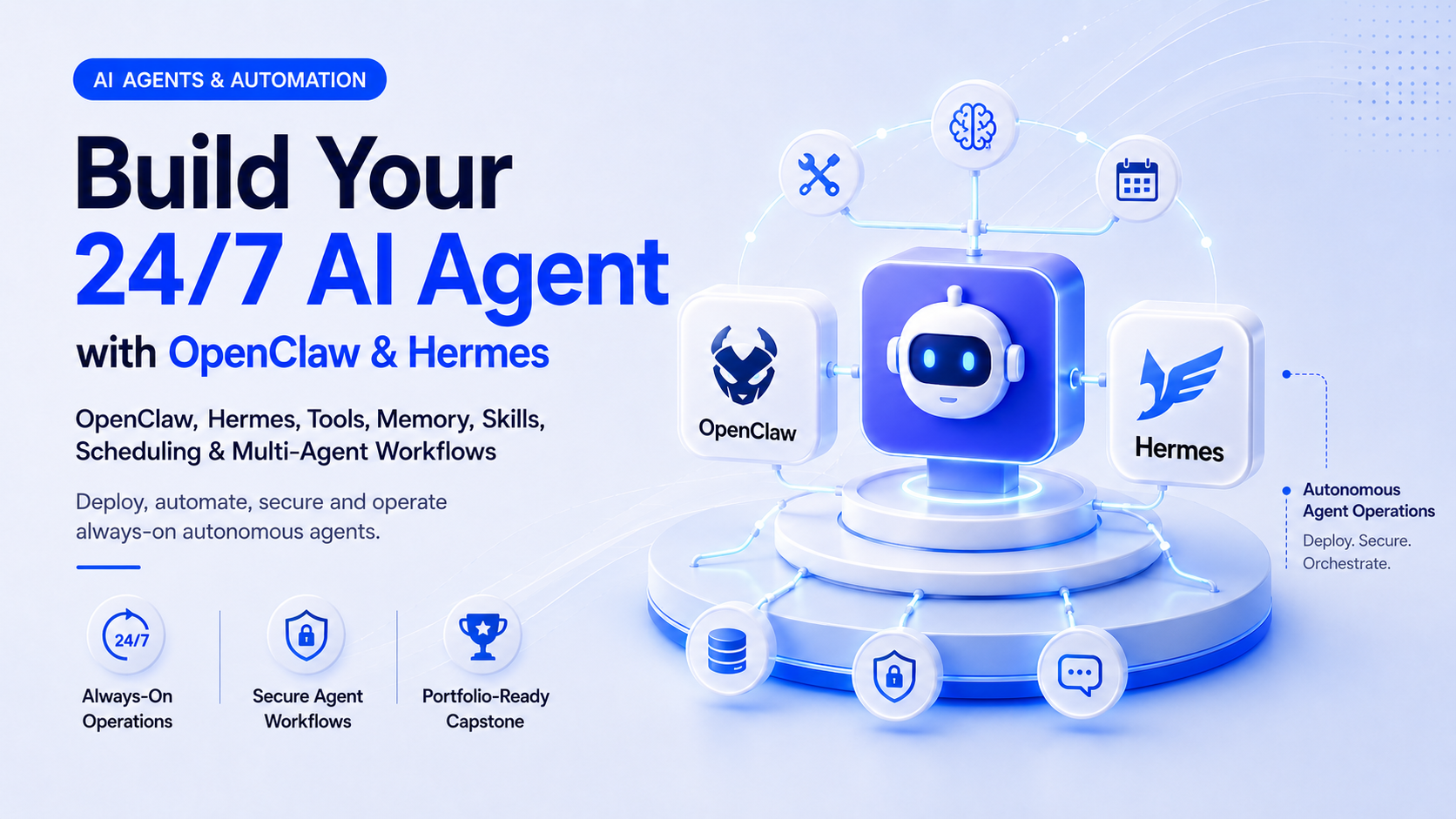
Build Your 24/7 AI Agent with OpenClaw & Hermes
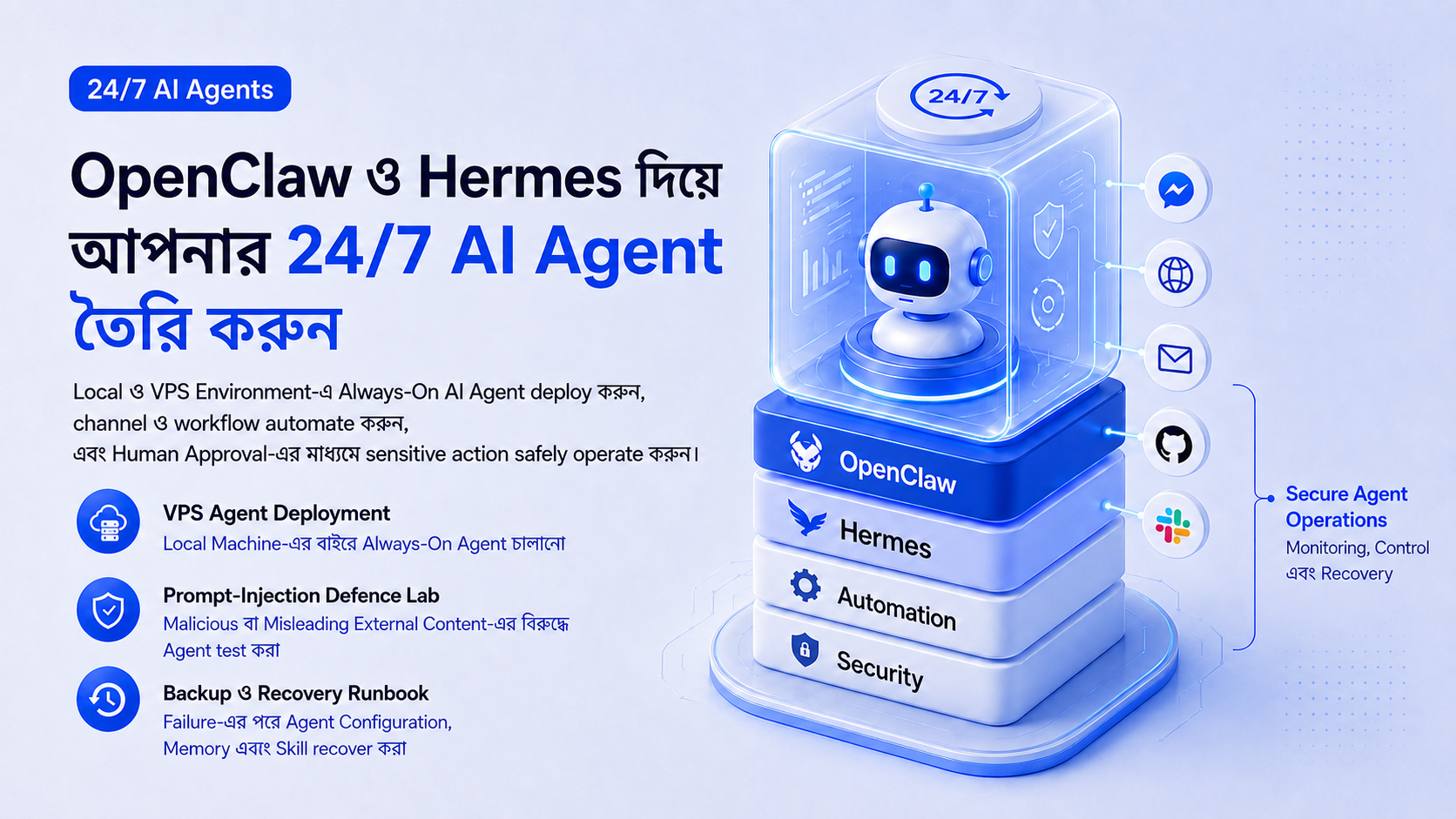
Level: intermediateLanguage: English / বাংলা
Enrolment opened Sep 15, 2026
Build Your 24/7 AI Agent with OpenClaw & Hermes
Do not just install an AI agent. Learn how to deploy, automate, secure and operate one that can work for you around the clock.
Build and operate always-on autonomous AI agents using OpenClaw and Hermes. This live frontier technology sprint goes far beyond installation: students deploy agents locally and on VPS infrastructure, connect messaging channels, configure cloud and local models, build tools and reusable skills, manage persistent memory, schedule unattended jobs, automate browser, email, calendar and GitHub workflows, delegate work to specialist agents, and implement human approval for sensitive actions. A major emphasis is Secure Agent Operations, including least-privilege permissions, sandboxing, secret management, allowlisting, prompt-injection defence, skill inspection, audit logs, backup, recovery and emergency shutdown. The final two weeks are dedicated entirely to building a portfolio-ready capstone.
Personal and business AI agents are rapidly moving from chat interfaces to systems that can remember context, use tools, interact with external applications, run scheduled jobs and perform multi-step work with limited supervision. This course teaches students how to engineer and operate these systems with OpenClaw and Hermes. Students begin with architecture, deployment and model configuration, then move into channels, tools, skills, memory, browser automation, external integrations, scheduled workflows and specialist-agent delegation. The final technical phase focuses heavily on Secure Agent Operations, observability, cost control, backup and recovery. Because OpenClaw and Hermes evolve quickly, the live lab environment and framework-specific implementation exercises should be reviewed and refreshed before every cohort. Students finish with a dedicated two-week Capstone Studio and one substantial portfolio-ready autonomous agent system.
This is not an OpenClaw installation course. It is an Autonomous Agent Operations course.
Students learn the complete lifecycle of an always-on agent — deployment, tools, memory, automation, security, monitoring and recovery.
Deploy OpenClaw and Hermes locally, with Docker, and on VPS infrastructure
Understand the architectural differences between OpenClaw and Hermes
Configure cloud models, local models and model fallback strategies
Connect agents to Telegram, Discord, Slack, WhatsApp or other supported channels
Create custom tools and reusable skills for real workflows
Design persistent memory without turning memory into an uncontrolled data dump
Run scheduled and event-triggered unattended workflows
Automate browser, email, calendar, GitHub and reporting workflows
Delegate work to specialist agents and coordinate multi-agent workflows
Require human approval before sensitive or destructive actions
Apply least privilege, sandboxing, allowlists and secret-management practices
Defend against prompt injection and untrusted external content
Inspect third-party and agent-generated skills before trusting them
Monitor token usage, cost, errors and unattended agent behaviour
Build backup, restore, recovery and emergency shutdown procedures
Master the modern stack
8 modules · 166 lectures
1.1 From Chatbot to Autonomous Agent
- 1Chat interaction versus tool-using agent execution
- 2Agent loop, tools, skills, memory, sessions and external actions
- 3Always-on agents versus request-response AI applications
- 4Why persistent agents require stronger operational controls
1.2 OpenClaw Architecture
- 1Gateway, agents, sessions, channels, tools and skills
- 2Multi-channel message routing
- 3Agent workspaces and isolated sessions
- 4Automation surfaces including scheduled jobs and webhooks
1.3 Hermes Architecture
- 1Agent runtime, tools, toolsets, sessions and integrations
- 2Persistent memory and long-term user or project context
- 3Reusable skills as procedural knowledge
- 4Skill creation and improvement workflows
1.4 OpenClaw vs Hermes
- 1Gateway-oriented architecture versus agent-centred workflow patterns
- 2Memory, skills, tools and automation differences
- 3When each framework is a stronger fit
- 4Avoiding framework lock-in by designing portable workflows
Run Your First OpenClaw and Hermes Agents
Install both frameworks in isolated development environments, configure a model provider, run basic conversations, inspect sessions and compare their configuration and runtime structure.
Week 1 assignments
22 hands-on builds. One serious portfolio.
3 phases. 3 production-ready systems.
Secure Multi-Channel Agent Gateway
Phase 1 — Combines Architecture, Deployment, Models and Channel Security
Autonomous Daily Operations Agent
Phase 2 — Combines Tools, Skills, Memory, Scheduling and Delegation
Secure Agent Operations Drill
Phase 3 — Security, Reliability, Cost and Recovery
You will ship 2 guided capstones — chosen from high-impact tracks
You will graduate with 2 production-grade capstone systems — guided step-by-step by your instructor. The full briefs, blueprints, and starter assets are unlocked the moment you enroll.
Capstone Project Track A
- Lorem ipsum dolor sit amet, consectetur adipiscing elit.
- Lorem ipsum dolor sit amet, consectetur adipiscing elit.
- Lorem ipsum dolor sit amet, consectetur adipiscing elit.
Capstone Project Track B
- Lorem ipsum dolor sit amet, consectetur adipiscing elit.
- Lorem ipsum dolor sit amet, consectetur adipiscing elit.
- Lorem ipsum dolor sit amet, consectetur adipiscing elit.
- Developers who want to run practical autonomous agents outside a normal chat interface
- Automation engineers who want to build persistent, always-on agent workflows
- DevOps learners who want to deploy, monitor and secure AI agent infrastructure
- Backend engineers exploring autonomous AI operations
- Technical freelancers who want to build custom AI agents for clients
- Startup builders who want an internal AI operations assistant
- AI engineers who want practical experience with tools, memory, skills, scheduling and multi-agent routing
- Advanced AI users who already understand LLM basics and want to operate autonomous systems safely
- Basic command-line familiarity
- Basic understanding of APIs, JSON and web applications
- Basic Git and GitHub familiarity is recommended
- Basic Linux or server knowledge is helpful but not mandatory
- Comfort installing developer tools and working with configuration files
- No prior OpenClaw or Hermes experience required
Meet your instructors
Industry practitioners and academics who designed this curriculum around real production automation workflows.

Mahmudul Hasan
- B.Sc — BUET
- MBA — IBA, DU
- Senior Software and Data Engineer, Bedata Solutions Ltd

K M Khadimul Hasan
- BBA, MBA — DU
- Ex — KPMG Bangladesh
- Ex — Brain Station 23

Mahady Hasan Rafy
- PhD Fellow, University of Memphis, US
Do not just install an AI agent. Learn how to operate one safely 24/7.
By the end of this course, you will have deployed always-on agents, connected real channels, created tools and skills, managed persistent memory, built scheduled workflows, delegated work between agents, secured sensitive actions, tested prompt-injection defences, monitored cost and failures, and completed a portfolio-ready autonomous agent capstone. The course deliberately treats OpenClaw and Hermes as rapidly evolving technologies, so framework-specific labs are refreshed before each cohort while the core engineering principles remain portable.
You will finish with
- 6 focused core modules
- 12+ hands-on assignments
- 3 practical phase projects
- Dedicated 2-week Capstone Studio
- 2 substantial portfolio capstone options
- OpenClaw + Hermes practical experience
- Secure Agent Operations as a core skill
- Cohort-specific lab refresh for fast-moving tools
- Architecture, security, operations and demo documentation
Pay your way — backed by a money-back guarantee
Pick the plan that fits your cash flow, and start with the confidence of a refund window.
50 / 50 split
Most popularHalf at enrollment, half at the midpoint — Week 4 checkpoint.
Payment 1
৳5,000
At enrollment
Payment 2
৳5,000
Week 4 checkpoint
- No interest and no plan fee — the total is unchanged
- Uninterrupted access between the two payments
Installments carry no interest and cost no more than paying in full. Your seat is confirmed once the first payment is verified.
Try the first classes. Not for you? Get your money back.
If the course is not the right fit, request a refund within 7 days of the cohort start and we return your payment.
Conditions applied
- The request must be made within 7 days of the cohort start date.
- No more than 3 live classes attended, and no capstone material downloaded.
- Refunds are sent back to the original bKash or bank account within 10 working days.
- Transaction and gateway charges are not refundable.
- Scholarship and discounted seats are not eligible.
On the 50 / 50 plan, the refund window closes well before the week 4 checkpoint, so you always decide before the second payment.
Ready to build it for real?
Join Inception 23 Academy and ship production-grade systems in weeks, not months.